The Box With No Label: A Saturday Morning at the Village Auction
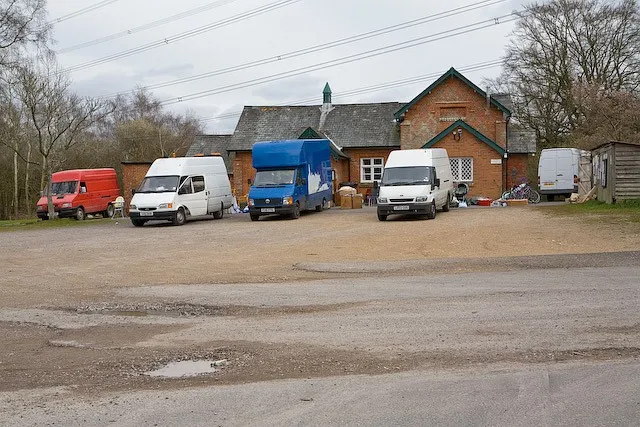
Photo: Peter Facey, CC BY-SA 2.0, via Wikimedia Commons
The doors open at half past eight, but the regulars are already there by twenty past. Some are leaning against the radiators. Some are circling the trestle tables with the slow, deliberate gait of people who know that browsing is part of the ritual. And some are standing in the queue for the bacon butties, because no village auction in 2026 can begin without the smell of slightly burnt bread and the clatter of a tea urn that has clearly seen things.
This is not Christie’s. Nobody is wearing gloves. The lighting is fluorescent, the carpet is patterned in a way that suggests it was chosen in the 1980s and defended ever since, and the lots are laid out on folding tables with the sort of numbering system that relies on hope and a roll of masking tape. But it is an auction all the same, and it has its own rules.
The ritual of the first lap
The first lap is not really about looking. It is about being seen looking. You nod at the woman who always bids on brass. You say good morning to the man who buys old tools and never uses them, and who will tell you, if pressed, that he is ‘saving them for somebody’. You slow down by a box of mismatched china and pretend to consider it, even though you have no need for another gravy boat. The point is not the gravy boat. The point is the being here.
By nine o’clock, the hall has filled. There is a couple in their thirties taking photographs of a pine blanket box with the cautious excitement of first-time buyers. There is a bloke in a fleece who has come for one specific thing — a vice, maybe, or a set of spanners — and who will leave with that thing plus three carrier bags of mystery. And there is Doreen, who has been coming since before anyone can properly remember, and who sits at the front with a flask and a look that says she has seen every lot worth seeing.
What the lots actually are
The catalogue, such as it is, is a photocopied sheet with descriptions that manage to be both precise and vague. ‘Box of oddments.’ ‘Qty of kitchenware.’ ‘Vintage tools.’ ‘Carrier bag, contents unchecked.’ The carrier bag is the great unknown of the village auction. It might contain a whisk and a half-used candle. It might contain a set of keys to a house that no longer exists. It might contain a paperback novel with a bus ticket from 1998 marking page 74. You do not know. That is the point.
There is a strange democracy to it. A box of inherited tools sits next to a framed print of a Highland cow. A set of golf clubs leans against a wicker hamper. Nothing is curated. Everything is simply here, having arrived by way of house clearances, garage tidy-ups and the occasional ‘if nobody wants it, it’s going to the auction’ decision made on a Sunday afternoon.
The bidding, and the pause
The auctioneer is a local man with a gavel that looks like it was made in a shed, and a rhythm that owes more to conversation than commerce. He does not rush. He knows the room. He knows that the brass candlesticks will go to the woman in the green coat, and that the box of railway magazines will go to the man who always sits near the door. He knows that the first few lots will be slow, and that the room will warm up once somebody gets a bargain.
Bidding is not a blood sport here. It is closer to a series of small, polite enquiries. A hand lifts. A head tilts. Somebody says ‘go on then’ and immediately regrets it. The auctioneer says ‘ten, ten, ten’ in a voice that sounds like he is reciting a poem. Then there is a pause — the long, slightly awkward pause that every auction needs — and somebody bids five pence more. The gavel comes down. The room exhales.
The economics of ‘worth something’
The sums are small. A box of oddments might go for two pounds. A decent hand drill might make twelve. The pine blanket box will go for more, because it is useful and it is not broken, but even then nobody is planning to retire on the proceeds. There is a buyer’s premium, and a queue to pay, and a man with a list who ticks you off and says ‘that’s the one with the green sticker, isn’t it?’
But the economics are not really about money. They are about reuse. Every lot that leaves the hall is one less thing in a skip. Every box of oddments that finds a new home is a small act of resistance against the idea that things are disposable. And every carrier bag with unchecked contents is a reminder that value is not fixed — it is something we decide, together, in a room with bad lighting and a tea urn.
What comes home
By midday, the hall is emptying. People are carrying things to cars. Somebody is strapping a lamp to a bike. Somebody else is trying to fit a set of drawers into the back of a hatchback while a friend offers advice that is not helping. The auctioneer is packing up his gavel. Doreen is finishing her flask. The tables are being folded away.
And what has actually happened? A few hundred pounds has changed hands. A few dozen objects have been rescued from the tip. A few stories have been retold — the one about the box that turned out to contain a war medal, the one about the man who bought a wardrobe and found a letter hidden behind the drawer, the one about the tea urn that has been at every auction since anyone can remember.
In 2026, when so much of life happens on a screen, there is something quietly radical about a Saturday morning spent in a draughty hall, bidding three pounds fifty on a box you do not need. It is not nostalgia. It is not thrift, exactly. It is the simple, stubborn business of keeping things in circulation — and keeping each other in view while we do it.
So if you find yourself with a free Saturday, and a fiver in your pocket, and a vague curiosity about what might be in that carrier bag with no label, you know where to go. The tea urn will be on. The gavel will be ready. And somewhere in the room, somebody will be bidding on a box of oddments, not because they need it, but because it is there — and because, for a moment, it is theirs.