Six Eggs, a Clipped Price List and the Tin That Trust Built
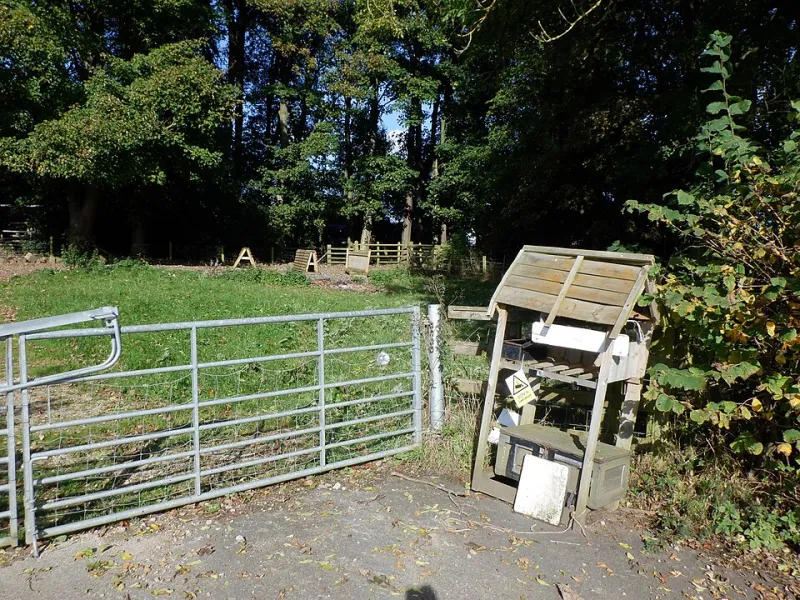
Photo: Richard Webb , CC BY-SA 2.0, via Wikimedia Commons
The sign is the first thing you see: a rectangle of laminated A4, zip-tied to a gate, sun-bleached at the corners. FREE RANGE EGGS. HALF DOZEN £2.20. PLEASE LEAVE MONEY IN THE TIN. THANK YOU. Beside it, a cool box on a pallet, a stack of pulp cartons, and a coffee tin — the old-fashioned kind, red and gold, with a slot cut into the lid and a stone on top in case the wind gets ideas.
There is no card reader. No QR code. No one watching from the hedge. Just eggs, a price, and a tin. And yet, on a damp November morning in 2026, the system works. It works because most people would rather be decent than be caught being otherwise.
The half-dozen economy
A half-dozen is a very specific unit of neighbourly scale. It is enough for breakfast and a cake, small enough that the money is rarely more than a couple of pounds, and repeatable enough that a stand can become a habit. You do not need a loyalty app to buy six eggs from a table at the end of a drive. You need to remember to bring a pound coin and a twenty-pence piece, or to trust that the tin will have change.
The stands are everywhere once you start looking. A garden wall in Somerset with jars of marmalade and a plastic tub of coins. A former phone box in the Fens turned into a tiny larder: potatoes, onions, a bunch of parsley, a notebook with prices in biro. An allotment gate in a Yorkshire village where someone has left a set of kitchen scales, a cardboard sign reading HELP YOURSELF, and a Tupperware box with a slot cut in the lid. The produce changes with the season. The tin does not.
What these places sell is not just food. It is a small, unstaffed shop that keeps money in the village and keeps the village in the habit of seeing itself. The eggs are fresher than most supermarket eggs. The courgettes are marrows with self-esteem. The marmalade was made in a kitchen that smells of oranges and radio. And the whole transaction takes about forty seconds, most of which is spent deciding whether to leave the change.
A tin, a notebook and a certain kind of arithmetic
The coffee tin is the heart of it. I have seen tins with slots cut into the lid, tins with a child’s padlock, tins that were once full of Quality Street and now hold a fiver in coins and a note saying SORRY, NO CHANGE — PAY NEXT TIME. The tin is a cash box, a suggestion box and a miniature bank. It is also a ledger of a kind: not of names, but of small decisions.
At one stand outside a village near Lincoln, the tin lives in an old metal filing box on the bottom shelf of a cool cabinet. The price list is clipped to the door with a bulldog clip: six eggs £2.20, twelve £4.20, duck eggs £3.50. There is a secondhand ice-cream tub for the money and a hand-written note that says IF YOU HAVE NO CHANGE, POP BACK TOMORROW. The farmer, Martin, checks the tin at night. Not to catch anyone out, he says, but to see whether he needs to put more change in.
That is the detail that stays with me. The tin is not policed. It is maintained. Someone notices when it is low on coins. Someone notices when the notes are getting damp. Someone notices when a customer has left a fiver for a half-dozen and not taken the change, which happens more often than you might think. The tin is a small piece of social infrastructure, and it is looked after like one.
When the money doesn’t add up
It would be sentimental to pretend the system never fails. It does. Eggs get taken. Tins get emptied. A fox gets into the hen house, a wasp gets into the cool box, a storm takes the sign. There are stands that have closed after a bad week. There are farmers who have put up a camera and hated themselves for it.
But the losses are usually small, and the stories are usually more interesting than the crime. The note on one gate — BACK AT 4, PLEASE LEAVE MONEY IN THE TIN — is a kind of contract. The note on another — SORRY, I OWE YOU 20P, I’LL BE BACK SATURDAY — is a kind of credit system built on faces. The person who forgot their wallet and promised to return usually does. The person who took a punnet of raspberries without paying usually comes back with a pound and an apology, because the stand is not anonymous. It is at the end of a lane. Someone knows someone who knows.
This is not naive. It is a calculated risk, and the calculation is that most people are all right. The stand is a small test of that proposition, repeated daily, and it passes more often than it fails. In a year when so much of life has been moved into apps and accounts and terms and conditions, there is something quietly bracing about a system that runs on a coffee tin and a reasonable expectation of decency.
The unstaffed shop as local media
There is another function these stands perform, and it is easy to miss. They are a form of local media. A noticeboard made of produce. You learn who keeps hens, who grows too many runner beans, who makes sloe gin, who has a glut of apples and a spare table. You learn the seasons from the price list: rhubarb in spring, strawberries in June, courgettes in August, squash and leeks as the light goes.
The stands are also a quiet economy. They let small growers sell a surplus without opening a shop or signing up to a platform. They let a household turn a hobby into a few pounds of hen feed. They let a village keep some of its money circulating locally, which is a phrase that sounds like policy but is really just a description of what happens when you buy six eggs from a table at the end of a drive.
And they are a small education. Children learn to count coins, to read a price list, to leave the right money and shut the gate. They learn that trust is a practical thing, not a vague one. It is a tin with a slot in the lid and a stone on top. It is a sign that says thank you. It is the assumption that you will do the right thing, which is a surprisingly effective way of getting people to do it.
What the tin is really counting
As the nights draw in and the lanes get muddy, the stands get quieter. The eggs are still there. The tin is still there. The sign has been updated with a marker pen: WINTER HOURS — HONESTLY, JUST TAKE WHAT YOU NEED AND LEAVE WHAT YOU CAN. It is the kind of instruction that could only work in a place where people know each other, and it works because the place is made of people who know each other.
I drove home with six eggs on the passenger seat and a coffee tin rattling in my head. It is a small thing, a roadside stand. It will not scale. It does not need to. It is a reminder that trust is not a soft idea. It is infrastructure. It is the reason you can leave a table by a gate and go back to your kitchen, and the reason someone will leave £2.20 in a tin and take their eggs home for tea.