Quarter Past Three: The Unelected Committee at the School Gate
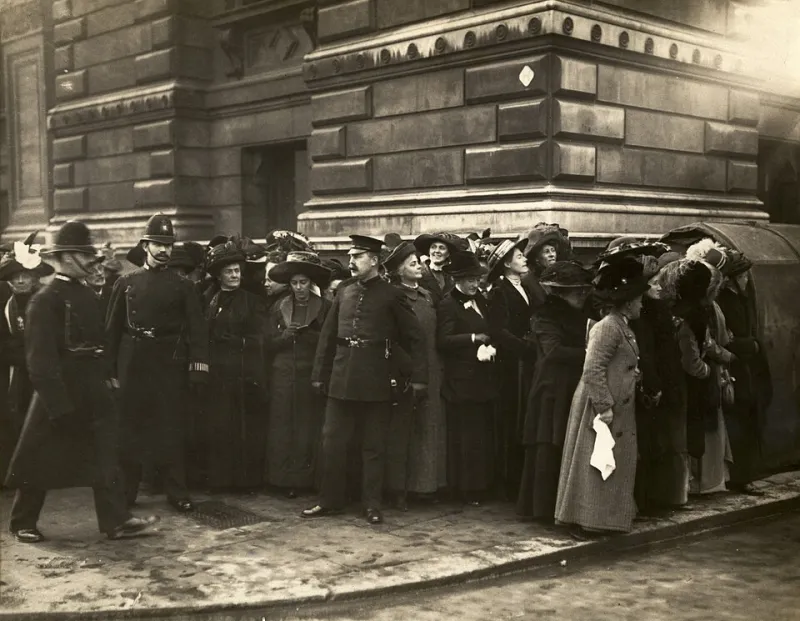
Photo: Unknown, No restrictions, via Wikimedia Commons
There is a sound a village makes at quarter past three, and it is not the one that ends up on the postcard. No church bells, no birdsong, no distant tractor. It is a hatchback idling outside number fourteen with the radio still on, a metal gate being scraped open by someone in a hurry, and a crossing patrol saying the same joke she has said since roughly the last time the road was resurfaced.
It lasts about twenty minutes. It does more civic work than most things that last all year.
The half hour before: engines, umbrellas, the last sausage roll
By ten past three the kerb outside the primary is a soft jam of cars, most of them parked with the slightly apologetic angle of people who know they are technically in the way and have decided to be philosophical about it. Engines tick. Wipers squeak on the half-setting. Somebody's dog is in the boot of an estate car, breathing heavily and having, by all appearances, the best day of its life.
The baker's is the barometer. The last sausage roll goes at about seven minutes past — always to somebody who insists they are not having one, and then eats it standing up, facing slightly away from the road, as though this makes it a private matter. By twelve past, the hot counter is a tray of crumbs and the queue has become a conversation.
And then the crossing lady. She is the closest thing the village has to a master of ceremonies, and she works the crowd like a professional. She remembers which child has a poorly gran, which dad is on nights, which pushchair has a wobbly wheel that needs a bit of a shove at the kerb. She also has material. The jokes are not new. Nobody wants them to be new. A joke you have heard four hundred times at the same zebra crossing starts to function less as comedy and more as a sort of clock.
Weather does not cancel this. Weather just changes the costume. In November it is hoods and headlights and the specific grey light that makes everyone look slightly unwell. The umbrellas come out and immediately become a small social problem, because a pavement is only so wide and there is a whole etiquette to who tilts, who ducks and who pretends not to have noticed.
A committee that has never once taken minutes
Here is the thing about the school run that nobody puts in the newsletter: it is the village's most reliable social network, and it runs on nothing but repetition.
Nothing is scheduled. No one is in charge. There is no rota, no chair, no treasurer with a shoebox of receipts. And yet, in the space of a fortnight, you will hear about a lost cardigan, a broken boiler at the church hall, a spare ticket for the fireworks, a job going at the garden centre, a hedge that needs cutting and a fun run that definitely needs more marshals. You will hear it from someone who heard it from someone, and by Friday it will have sorted itself out.
This is how most things in a village actually get done — not through announcements but through standing next to each other in the drizzle for eleven minutes. The school gate is where information arrives before it has been properly formatted. It is the rough draft of everything.
What makes it work is that it is compulsory. You cannot skip the school run the way you can skip a meeting. You have to be there, three fifteen, rain or shine, and so does everyone else. Shared obligation, it turns out, is a far stronger social glue than shared enthusiasm.
The quiet rules of the pavement
None of this is written down, and all of it is enforced.
Do not block the drive. Do not take the space by the corner, that one is hers. If you arrive after twenty past, you park further down and accept it. If someone is new, you say hello, but you do not ask three questions in a row. If a child comes out with one shoe, you wait, because the adult dealing with it does not need advice, they need a bit of room.
The bow at the school gate is a genuinely delicate operation: two adults, both half-facing the door, both pretending to be watching for their own child while conducting a full conversation about a fence, a funeral and whether the chip shop has changed hands. Nobody admits to gossiping. Everybody is, gently and usefully, keeping the whole thing ticking over.
The ones who never quite go home
Then the doors open and it all inverts. For four minutes the pavement is a wall of noise — bags, coats, half-eaten snacks, the specific wail of a small person who has been promised something and is now being told no. The crossing lady does her busiest shift. Somebody's nan does a pickup and is instantly the most popular adult on the street.
And after that, the second half. Because a good number of people do not leave. They drift to the wall by the rail, or to the bench that has one slat replaced in a slightly different wood, and they stay. Ten minutes. Sometimes twenty-five. The children run in loops and argue about something imaginary. The adults talk about Christmas, then about someone's extension, then about a recipe, then about nothing at all.
These are the ones who hold the village together, and they do it without ever calling it that. It is not nostalgia, and it is not a social club. It is just a few people deciding that the walk home can wait a bit.
What the ten minutes are actually for
We tend to describe the school run as a chore, and it is — the parking, the timing, the glovebox full of crisp packets and letters you have not read. But stand at the gate for a week in 2026 and a different picture emerges. It is the one appointment everybody keeps. It is the village's rolling meeting, its noticeboard, its lost property office and its support network, all at once, all conducted in a coat.
So next time the bell goes and you find yourself still there at half three, having heard about a boiler, a hedge and a wedding, do not apologise for it. You have just attended the most efficient committee in the parish. Nobody took minutes. It will all get done anyway.