One Piece at a Time: The Window Table Where Nobody Is in a Hurry
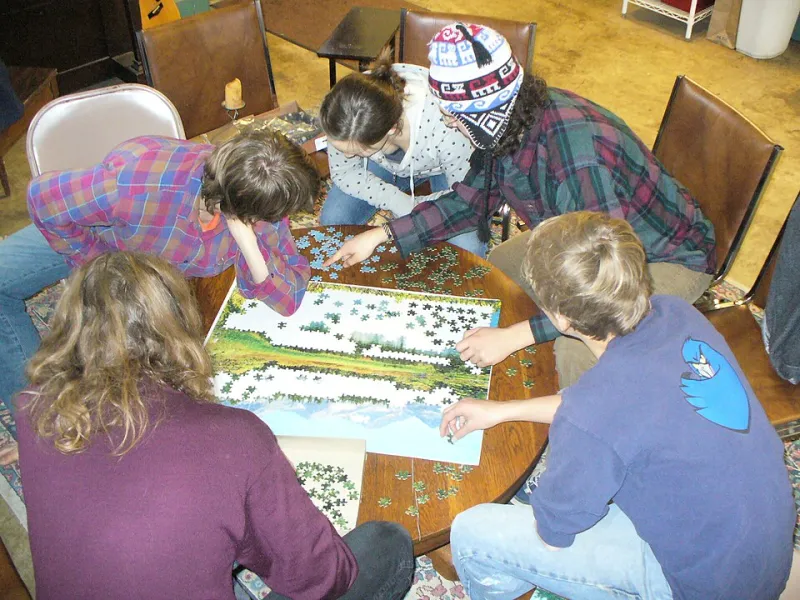
Photo: Artaxerxes, CC BY-SA 3.0, via Wikimedia Commons
On a wet Tuesday in November, the best seat in the library is not by the radiator. It is the narrow table pushed up against the window, where a 1,000-piece jigsaw of a Suffolk harbour is currently half sea, half sky, and entirely in the way of anyone trying to reach the local history shelf.
Nobody minds. The table has been there since the spring, more or less, and in that time it has developed the sort of quiet social life that rarely makes the parish newsletter. People drift towards it. They stand for a minute. They pick up a piece. They stay for twenty.
The Table That Started Itself
The jigsaw was not launched with a ribbon-cutting or a rota. According to the library desk, it began when someone donated a box during a clear-out and a member of staff put it out “just to see”. Within a week, the corners had been assembled. Within a fortnight, a small group of regulars had adopted it without ever formally volunteering.
There is a retired teacher who does the sky. There is a man who comes in for the newspapers and claims he is not doing the puzzle, then spends fifteen minutes on the chimney pots. There is a teenager who once solved a tricky section of rigging in about four minutes and has been treated with quiet respect ever since.
The beauty of it is that nobody is in charge. There is no chair, no treasurer, no WhatsApp group deciding the next image. The puzzle simply exists, and people respond to it in the way they might respond to a cat asleep on a wall: gently, briefly, and with an odd sense of shared responsibility.
Edge Pieces and Other Small Civilities
Any communal jigsaw develops rules, even if no one has written them down. The first is that edge pieces are fair game but should be placed rather than pocketed. The second is that you do not “claim” a section with a passive-aggressive pile of pieces. You can work on the boats, but you cannot annexe the boats.
The third rule is subtler: if someone is clearly mid-flow, you leave them to it. There is a particular look — head tilted, one piece hovering above the table, eyes narrowed — that means do not disturb. Most people recognise it instinctively. Those who do not are usually handed a cup of tea and gently redirected to the sky.
And then there is the matter of the missing piece. Every jigsaw has one, or claims to. At this table, the missing piece is not treated as a failure but as a small shared mystery. A note in careful handwriting currently sits under the box lid: “If found, please place. No questions asked.” It has been there for three weeks. Nobody has found it. Nobody has stopped looking.
The Missing Piece Is Not the Point
You might think the goal is to finish the puzzle. It is not. The finishing is almost incidental. The real purpose is the twenty minutes of low-stakes company that comes with it — the sort of conversation that starts with “I think that bit goes there” and ends with someone telling you about their aunt in Cleethorpes.
It is company without demand. You do not have to be interesting. You do not have to stay. You can arrive with a head full of things and leave with a slightly quieter one. The jigsaw gives your hands something to do while your brain settles, which is a rare and useful thing in a year that seems to run on notifications.
There is also the pleasure of small progress. A section of roof appears. A strip of sea connects to a strip of sky. Nobody claps. Nobody posts a photo. But there is a collective, almost imperceptible nod when a tricky bit finally locks into place. It is the same nod you see at a village hall when the urn finally boils.
A Slow Hobby in a Fast Year
In 2026, the jigsaw table feels quietly radical. It is analogue, shared and completely uninterested in being optimised. There is no app to log your pieces, no leaderboard, no way to prove you found the bit of the lighthouse first. The reward is simply that the picture gets a little clearer.
That may be why it attracts such a mixed crowd. Retired people, yes, but also shift workers, parents killing time before school pick-up, and at least one delivery driver who comes in for the loo and leaves having placed three pieces of a deckchair. The table does not discriminate. It only asks that you do not take the box home.
What the Window Shows
By the window, the light changes through the afternoon. The puzzle goes from bright to shadowed, and the pieces take on a different look. Someone switches on the lamp. Someone else puts the kettle on in the back room. The table keeps going.
It will be finished eventually, or it will be packed away when the next box appears. Either way, the table will remain. There will be another jigsaw, another missing piece, another note under the lid. And there will be people who come for the newspaper, or the warmth, or the quiet, and find themselves standing by the window for just a minute longer than they planned.
That is the thing about a shared puzzle. It does not ask much. It just leaves a chair, a few hundred pieces and the gentle suggestion that you might like to sit down.