The Nine O'Clock Ledger: Forty Years of Rain, Ruled in Ink
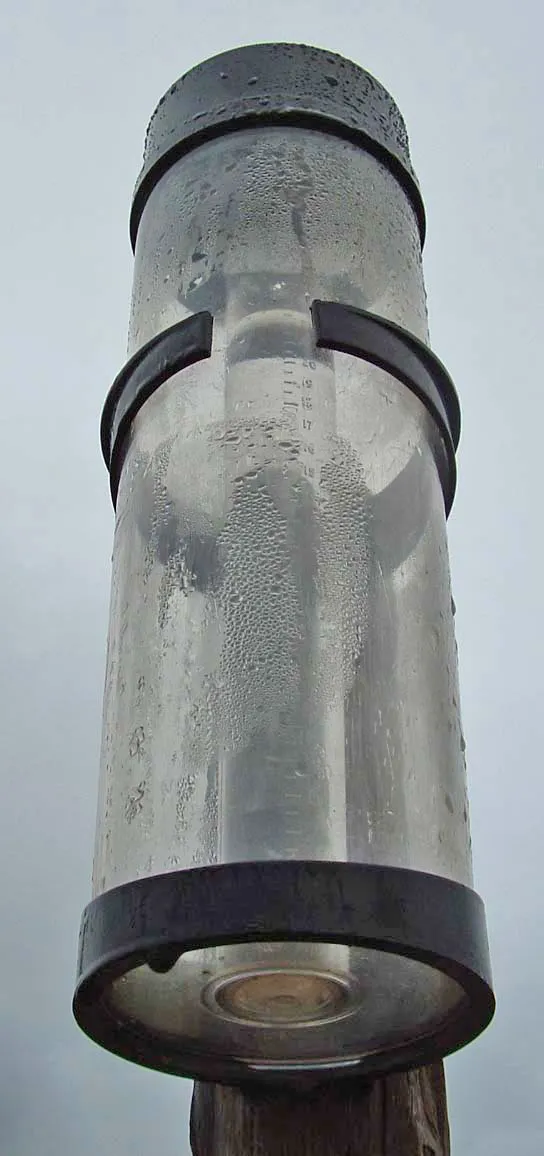
Photo: Bidgee, CC BY 3.0, via Wikimedia Commons
At 8.53 on a grey Tuesday in November, the shed at the edge of the recreation ground is still locked. By 9.02 it is open, the kettle is clicking, and the day's weather has been reduced to three figures in a hardback ledger. The rest of the village is still scraping windscreens. The rain gauge, a dull white cylinder on a post, has already done its talking.
Margaret — retired primary teacher, forty-year guardian of the village's weather record — does not make a performance of it. She lifts the inner tube, reads the millimetres, tips the water away, checks the thermometer, glances at the cloud. Then she writes. Date, time, rainfall, temperature, remarks. Sometimes the remarks say 'squally'. Sometimes they say 'two inches in the night, brook up'. Once, in 1998, they say 'wasps in the gauge'. The ledger does not editorialise. It simply holds.
A shed full of ordinary evidence
The shed is not a meteorological station in any official, laminated sense. It is a shed. There is a lawnmower with a missing handle, a stack of flowerpots, and a tin of screws that has outlived three governments. And there are the ledgers: nearly forty of them, in colours that once meant something — maroon, bottle green, a mustard yellow that must have been a job lot. Their spines are soft as cloth. Their pages smell of dust and pencil.
Margaret began in 1986, when the previous observer moved to Norfolk and left a note on the parish council table: 'Someone will need to take the readings.' She was teaching full time then, so the readings happened before assembly, in all weathers, with a mug of tea going cold on the windowsill. She has missed four mornings in four decades. Three were illness. One was a wedding in Whitby. Her neighbour covered that one and wrote 'sorry, I think I got the decimal in the wrong place' in the margin. The decimal was fine.
The noticeboard is the audience
By 9.15, the morning's figures are pinned to the parish noticeboard, under the poster for the Christmas fair and beside a card advertising a missing cat that has been missing since 2023. The sheet is plain: date, rainfall, temperature, a word or two about the sky. Dog walkers read it. The man who runs the allotment shop reads it and disagrees with it. A child on the way to school once asked Margaret whether she was 'the weather lady'. She said she was more of a weather clerk.
That is the right description. The volunteer weather observer is one of the last great acts of unpaid public record-keeping — a civic habit that asks for no login, no subscription and no applause. It is a small, stubborn answer to the idea that everything worth knowing must be scraped, sorted and sold. The figures are not dramatic. They are just there, every day, in ink, for anyone who wants to look.
What forty years can and cannot tell you
The ledgers do not settle arguments about the climate. Forty years is a blink. But it is long enough to give a village a local baseline: the wettest autumn in the book, the driest spring, the morning in 2010 when the thermometer refused to climb above minus nine. Margaret can tell you which winter the brook came over the road and which summer the allotment hoses were banned by the third week of June. She can tell you that the gauge has cracked twice, that the thermometer was replaced in 2004, and that the rain in October 2000 arrived with such force that it came in under the shed door and soaked a stack of Radio Times.
When people ask her about climate change, she is careful. She says the record is not a prosecution case; it is a diary. It shows what happened here, in this parish, at nine o'clock. It does not explain why. But it does make the conversation less abstract. A changing climate is harder to dismiss when it has a date and a rainfall total and a note in the margin about the brook.
The discipline of showing up
What strikes you, standing in the shed, is not the data. It is the routine. The padlock. The pencil on a string. The way Margaret checks the gauge even when the forecast says it will rain later, because later is not now. The weather is not a story she is telling; it is a job she is doing. And she has done it for so long that the village has stopped noticing, which is perhaps the highest compliment a public service can receive.
On the day I visit, the reading is unremarkable: four millimetres, seven degrees, cloud low and lumpy. Margaret writes it down, pins the sheet to the board, and puts the kettle on again. 'People think you need to be interested in weather,' she says. 'You don't, really. You need to be interested in turning up.'
The forecast for tomorrow is rain. The shed will be open at nine.